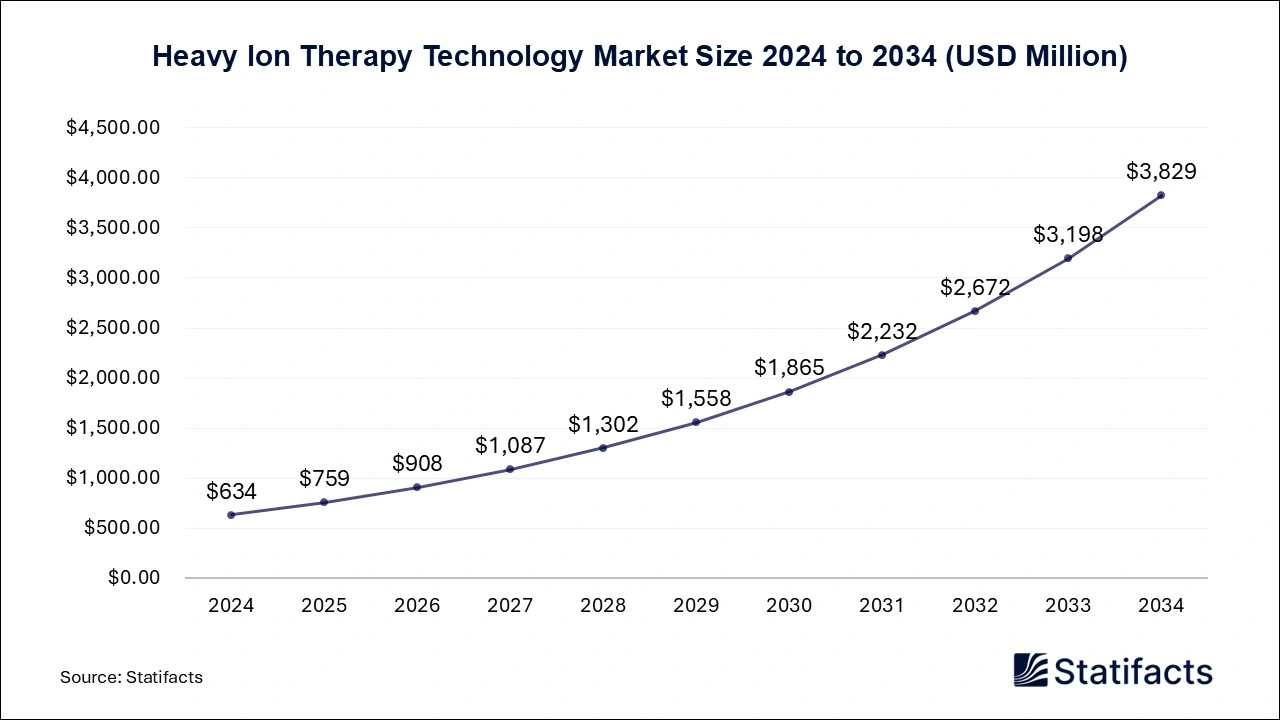
The global Heavy ion therapy market size was valued at USD 634 million in 2024 and is projected to reach USD 3,829 million by 2034, growing at a robust compound annual growth rate (CAGR) of 19.7% from 2024 to 2034.
Download Sample Databook@ https://www.statifacts.com/stats/databook-download/9048
In the realm of cancer treatment, radiation therapy has long been a cornerstone. However, the traditional methods of radiotherapy, like X-rays, have limitations in terms of precision, side effects, and effectiveness for certain types of tumors. Enter Heavy Ion Therapy (HIT) a cutting-edge technology that is revolutionizing the field of oncology by offering improved tumor control with minimal damage to surrounding healthy tissues. This article delves into the science behind heavy ion therapy, its advantages over conventional methods, and its growing potential in cancer treatment.
Heavy Ion Therapy Technology Market Statical Scope
| Reports Attributes | Statistics |
| Market Size in 2024 | USD 634 Million |
| Market Size in 2025 | USD 759 Million |
| Market Size in 2031 | USD 2,232 Million |
| Market Size by 2034 | USD 3,829 Million |
| CAGR 2025 to 2034 | 19.7% |
| Base Year | 2024 |
| Forecast Period | 2025 to 2034 |
What is Heavy Ion Therapy?
Heavy Ion Therapy is a form of particle therapy where cancerous tumors are irradiated with high-energy ions, such as carbon ions or protons, rather than conventional X-rays. The term “heavy ions” refers to atoms with a high atomic mass (greater than protons or neutrons), which are accelerated to high speeds in a particle accelerator before being directed at the tumor. The most commonly used heavy ions are carbon ions, but other elements such as neon, helium, and oxygen ions are also explored for their therapeutic benefits.
The Science Behind Heavy Ion Therapy
The core principle behind ion therapy is the Bragg peak phenomenon. When heavy ions enter the body, they deposit very little energy at the start of their path but release a concentrated amount of energy near the end of their trajectory, right at the Bragg peak. This allows for maximum radiation dosage to be delivered to the tumor, while minimizing the damage to the surrounding healthy tissues.
This effect is particularly significant for tumors located in difficult-to-reach or radio-resistant regions, such as those deep within the body or near critical structures like the spinal cord or brain.
How Does Heavy Ion Therapy Differ from Traditional Radiation Therapy?
- Precision and Effectiveness: Traditional X-ray radiation relies on photon beams that scatter and lose energy as they pass through the body. This means they can damage both cancerous and healthy tissues. In contrast, heavy ions, particularly carbon ions, have higher linear energy transfer (LET), meaning they deliver a more concentrated dose of radiation with greater precision at the tumor site.
- Higher Tumor Control and Radiosensitivity: Heavy ions are more effective at damaging tumor cells compared to conventional photon therapy, especially for radio-resistant tumors such as sarcomas or those that have spread to multiple organs. Carbon ions are particularly potent in inducing cellular DNA damage, triggering more effective tumor cell killing through both direct ionization and by producing free radicals that amplify the damage to cancer cells.
- Reduced Side Effects: The ability of heavy ion therapy to target tumors more accurately means a reduced risk of collateral damage to healthy tissues. This makes it especially beneficial for treating tumors located near sensitive organs or in pediatric patients, where the risks of conventional radiation are higher.
- Reduced Need for Repeated Treatment: Due to their higher effectiveness, heavy ions can sometimes achieve the same therapeutic effect as multiple sessions of conventional radiation therapy in just a few treatments. This can significantly improve patient outcomes and quality of life by reducing treatment durations and minimizing overall side effects.
Customize This Study as Per Your Requirement@ https://www.statifacts.com/stats/customization/9048
Applications and Benefits in Cancer Treatment
Heavy ion therapy is particularly advantageous for treating complex and inoperable tumors that are resistant to conventional radiation. Some of the cancers that benefit most from heavy ion therapy include:
- Head and Neck Cancer: Tumors in this region are often located near critical structures, such as the spinal cord, nerves, and the brainstem. The precision of heavy ion therapy makes it an ideal option for minimizing the damage to these vital tissues.
- Lung Cancer: For patients with early or locally advanced lung cancer, heavy ion therapy can be a more effective alternative to traditional radiotherapy, offering higher precision in targeting lung tissue while reducing the risk of collateral damage to the heart and esophagus.
- Prostate Cancer: For prostate cancer patients who have failed conventional radiation treatments, heavy ion therapy has shown to offer promising results, particularly in terms of reducing long-term side effects such as incontinence or sexual dysfunction.
- Pediatric Cancers: Due to the higher sensitivity of children’s tissues to radiation, heavy ion therapy’s ability to spare surrounding healthy tissues while delivering higher doses to tumors is a game changer for treating pediatric cancers like brain tumors or soft tissue sarcomas.
- Recurrent and Metastatic Cancers: Patients with tumors that are recurrent or have metastasized to difficult-to-treat areas benefit from the enhanced effectiveness of heavy ion therapy in controlling disease progression and reducing the size of tumors.
Global Adoption and Facilities Offering Heavy Ion Therapy
As of now, heavy ion therapy is available in a limited number of specialized centers around the world, with facilities located in countries like Japan, Germany, China, South Korea, and the United States. Japan leads the way in heavy ion therapy with several operational facilities, such as the National Institute of Radiological Sciences (NIRS) in Chiba, which has been conducting groundbreaking research and treatment since the 1990s.
Europe also has key centers like GSI Helmholtzzentrum in Germany, where significant clinical research and therapy have been conducted since the early 2000s.
However, the high cost and complexity of building and operating heavy ion therapy facilities have restricted its widespread availability. The cost of constructing such advanced particle accelerators can run into the hundreds of millions of dollars, limiting access primarily to well-funded medical institutions or countries with advanced healthcare infrastructures.
Challenges and Future Outlook
Despite its promising advantages, there are several hurdles that must be overcome to make heavy ion therapy more accessible:
- Cost: One of the main challenges facing the widespread adoption of heavy ion therapy is the high cost of setting up the infrastructure and equipment, which is often prohibitive for smaller hospitals or health systems. This also results in higher treatment costs for patients.
- Limited Availability: Currently, only a handful of facilities around the world offer heavy ion therapy, creating geographical disparities in access to this advanced treatment.
- Long-Term Effectiveness and Research: While early clinical results are promising, more research is needed to fully understand the long-term outcomes and potential risks associated with heavy ion therapy, particularly in terms of secondary cancer risks and the efficacy for rare tumor types.
- Technological Advancements: Further advancements in particle accelerators and beam delivery systems could reduce costs and improve the efficiency of heavy ion therapy. Miniaturization of particle accelerators and improved computational modeling for treatment planning are key areas of development.
Regional Market Insights
-
Asia-Pacific (APAC): The APAC region, particularly Japan, China, and South Korea, is expected to witness the fastest growth in the heavy ion therapy market. Japan has been a pioneer in the development and application of this technology, with established centers like the National Institute of Radiological Sciences (NIRS) in Chiba. The rise of healthcare infrastructure and an aging population in these countries is further driving market expansion.
-
Europe: Europe is another key market for heavy ion therapy, with Germany and Italy being significant players in the development and implementation of this technology. The European market is expected to grow due to the increasing prevalence of cancer and the technological advancements in radiation therapy.
-
North America: The United States is a major contributor to the North American market, with several research institutes and universities focusing on the development of heavy ion therapy systems. However, market growth in North America may be slower than in APAC due to the high cost of establishing treatment centers and the limited number of existing facilities.
Get your hands on the Premium Databook at a special price of just $1550! https://www.statifacts.com/order-databook/9048
Heavy Ion Therapy Technology Market Companies
- Toshiba
- Hitachi
- CASHIM
- Sumitomo Heavy Industries (SHI)
- Siemens (Varian)
Heavy Ion Therapy Technology Market Segmentation
By Type
- Heavy Ion Therapy System
- Protons Therapy System
- Others
By Application
- Hospital
- Research Institute
By Region
- North America
- Europe
- Asia Pacific
- Latin America
- Middle East and Africa
Get your hands on the Premium Databook at a special price of just $1550! https://www.statifacts.com/order-databook/9048
You can place an order or ask any questions, please feel free to contact us at [email protected]
Statifacts offers subscription services for data and analytics insights. This page provides options to explore and purchase a subscription tailored to your needs, granting access to valuable statistical resources and tools. Access here – https://www.statifacts.com/get-a-subscription
Contact US:
- Ballindamm 22, 20095 Hamburg, Germany
- Web: https://www.statifacts.com/
- Europe: +44 7383 092 044
About US:
Statifacts is a leading provider of comprehensive market research and analytics services, offering over 1,000,000 market and custoer data sets across various industries. Their platform enables businesses to make informed strategic decisions by providing full access to statistics, downloadable in formats such as XLS, PDF, and PNG.